We skipped Figma. (As a stockholder, this hurts to write.)
For a recent client project, we didn't open a design tool. No artboards, no components, no prototype held together with hopeful arrows pointing from one screen to the next. We built the website. A real one, running in a browser, responsive, clickable, alive. Feedback worked the same way: we transcribed the client review calls, fed the transcripts to Claude (Anthropic's AI assistant), and let it turn the notes into GitHub issues we worked through directly against the running site. Then a Craft CMS developer took it apart and rebuilt the components inside the CMS (Content Management System) the client would actually use, so they could own and maintain it themselves.
I keep thinking how strange that felt, but also, awesome.
The thing we normally treat as the finish line of design was our starting line. It felt like a small violation of the natural order, as if we'd skipped a sacred step. We hadn't. We'd skipped a step that only ever existed because, until recently, we had no other choice.
Before I make a larger claim about that, one promise:
This is not an arrival story. I'm not going to tell you AI (LLMs really, but you know what I mean) has finally delivered us to the real thing, the true medium, the end of the rainbow. Every generation of designers has believed some new tool was the arrival, the one that would finally close the distance between what we imagine and what we ship. They were all a little right and all completely wrong, because there's no end of the rainbow. There's only the next layer. AI is a layer. The GUI (Graphical User Interface) was a layer. There will be a layer after this one, and someone will write this same article about it, and they'll be right too. (We'll get to the layers, all of them, all the way down, in the next piece.) Hold onto that promise. It's the only thing that keeps everything after it honest.
Now the claim.
The material that fights back
Every craft is defined by the material it fights with. A sculptor works stone, and stone pushes back. It has grain and weight and a way of splitting that you either respect or ruin. A novelist works language, which resists in its own quiet way: the wrong word simply won't hold the meaning you need it to. A woodworker feels the tool bite differently with the grain than against it. The mastery of a craft is, in large part, mastery of a material that resists you.
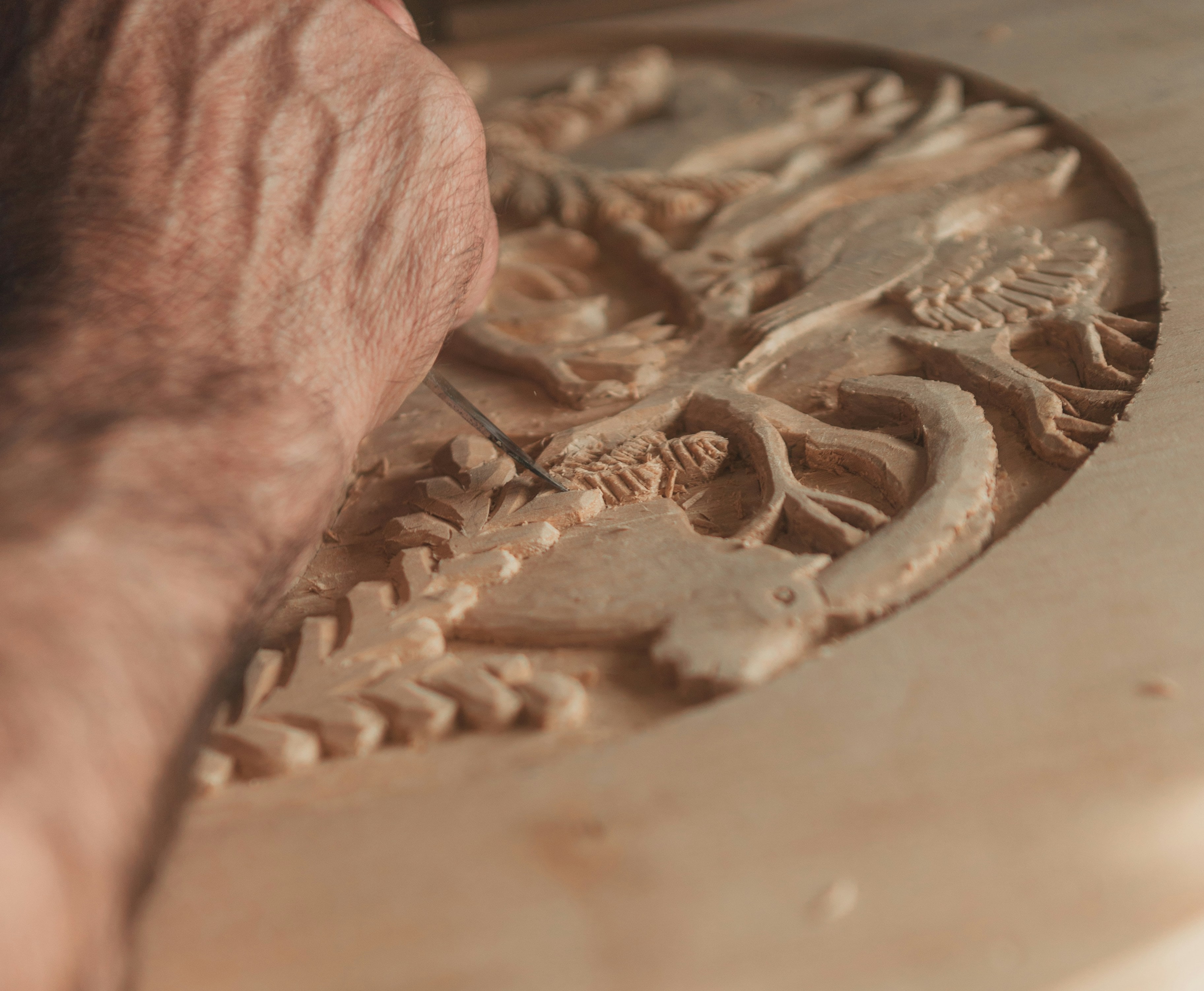
Photo by Alex Gruber on Unsplash
Digital designers have never touched their material.
I don't mean that as a metaphor. I mean it literally. Think about what actually happens when you "move" a rectangle on a screen. You slide a mouse across a desk, or drag a finger across glass. The cursor you're watching is itself a drawing, a little arrow the machine paints on the glass to stand in for your hand. A sensor reads the motion and turns it into numbers. Software interprets those numbers as an intention (she wants the rectangle over there) and updates a model held in memory, which is not a rectangle but a description of one: a short list of coordinates and color values. A rendering engine translates that description into instructions for the display. The display fires a grid of red, green, and blue subpixels. Photons leave the screen and land on your retina. Somewhere in that chain you "moved a rectangle." But you never touched a rectangle. There's no rectangle. There's a gesture, a stack of translations, and some light.
And it runs the other way, too. When you "delete" that rectangle, you destroy nothing. You tell the machine to stop drawing it. We don't push pixels, and we don't really make or unmake anything. We suggest, and a very fast, very literal collaborator obliges.
Even the thing that does appear isn't fixed. It re-renders on every device, reflows at every screen size, and shows up a little differently in every browser. Media theorists like Lev Manovich call this variability: a digital thing is never one settled object but a set of instructions re-performed each time it's shown. There's no single artifact to hold. There never was one to hold in the first place.
Content all the way in
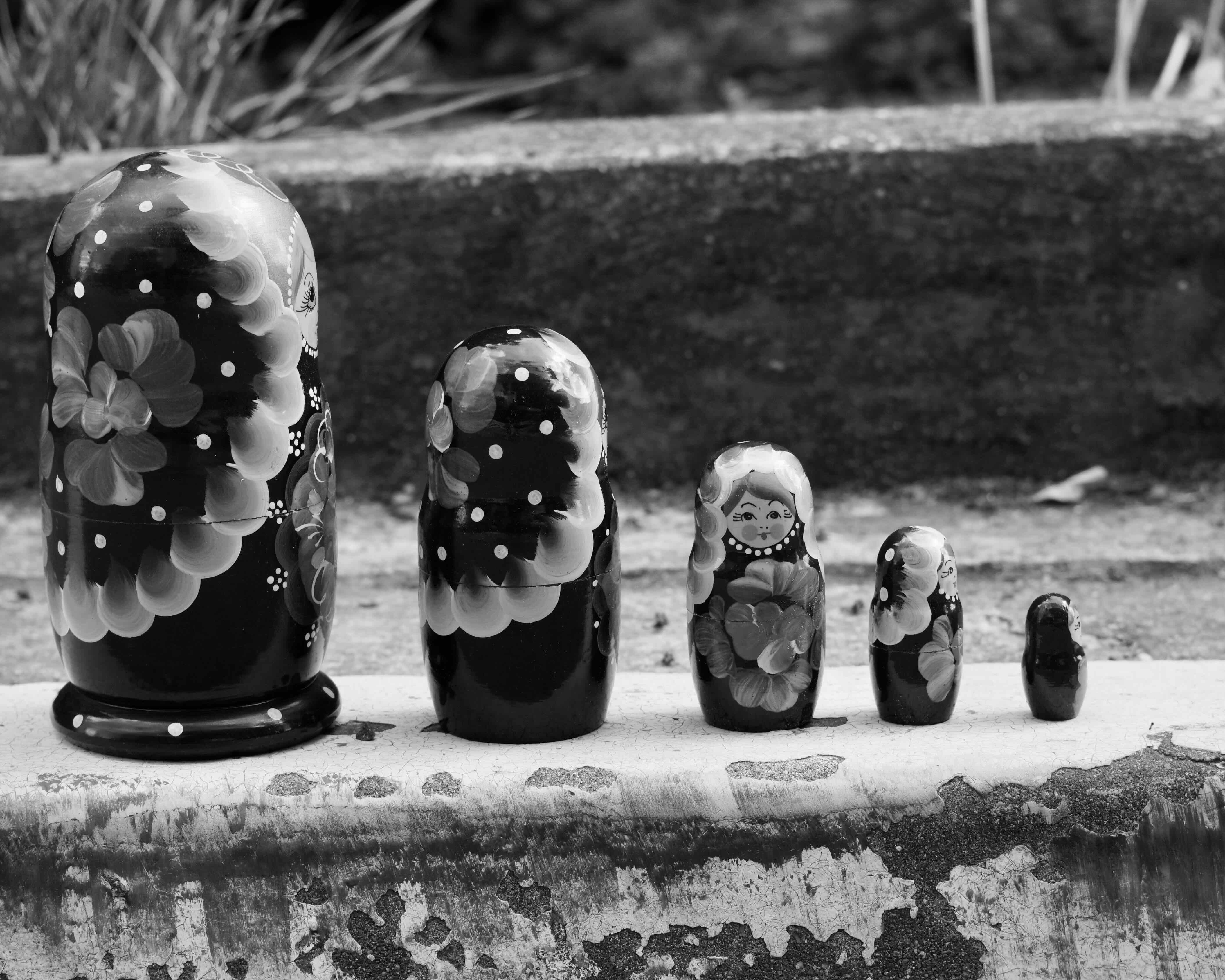
An idea that sounds like a riddle and turns out to be a floor plan: whatever is inside any medium is always another medium, like Matryoshka. The content of writing is speech. The content of print is writing. The content of a film is the novel or the play beneath it. You never reach the bottom. You just find another medium wearing the last one's clothes. That's Marshall McLuhan — a media theorist writing in the 1960s, and whose work and theories this whole series leans on.
Digital design is that nesting with no floor. The content of the screen is light. The content of the light is a rendered model. The content of the model is code. The content of the code is logic, which is math, which comes down, eventually, to the presence or absence of a charge in a sliver of silicon. Content inside content inside content, and nowhere in the stack is there a thing you could pick up and carry across the room. It's turtles, if you like. We'll come back to the turtles later in this series.
The most important idea we were never allowed to use
"The medium is the message" is McLuhan's most famous line and his most misread one. It doesn't mean "how you say it matters as much as what you say" (though that's a part of it). It means the medium itself (its shape, its speed, its grain) quietly reshapes how we think and what we're able to make, regardless of the content we pour into it. The medium is the thing doing the work on us, usually while we're staring at the content and paying it no attention. Churchill put the same idea more plainly: "We shape our buildings; thereafter they shape us."
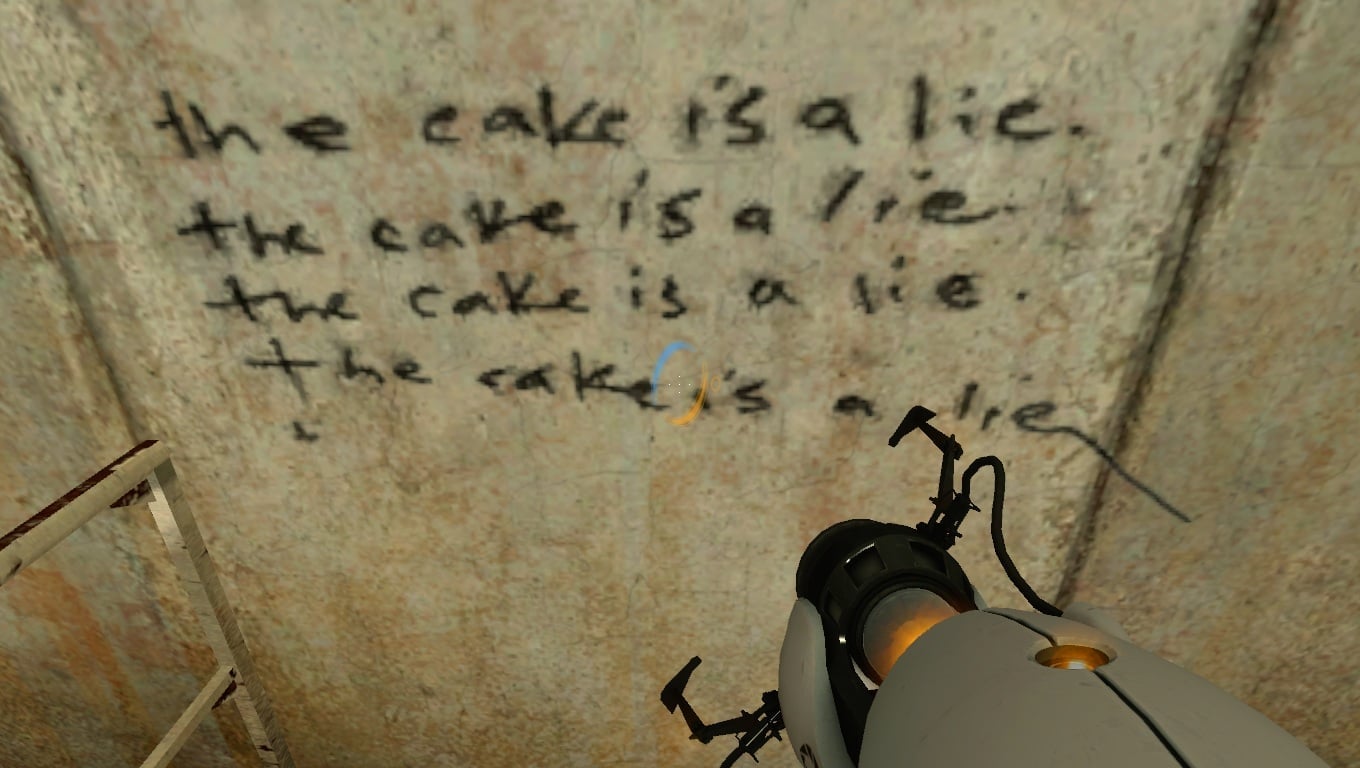
Portal players learned "the cake is a lie" the hard way. The promised reward was never real. Neither is the mockup.
The Figma is a lie.
But you can only be shaped by a medium you're actually working in. And digital designers, for our entire history, have not been working in our medium. We've been working in representations of it: pictures of software, drawn in tools that are, under all their sophistication, exceptionally refined descendants of the drafting table. We made a beautiful, convincing likeness of a thing that did not yet exist, and handed it to someone else to build in an entirely different material.
Which means the most important idea in media theory has, for us, stayed theoretical. We never had a medium of our own to be the message. We had notation, and we mistook the notation for the work.
Handoff was the symptom, not the practice
One of the godfathers of modern UX, Don Norman, gave designers a pair of words for the distance I'm describing, though he was talking about using products, not making them. There's a gulf of execution (the space between what you intend to do and what the system lets you do) and a gulf of evaluation (the space between what the system did and what you're able to understand about it). Good design narrows both until they nearly vanish and the tool feels like an extension of your hand.
Now look at how our discipline organized itself, and you'll notice we didn't just tolerate those gulfs inside our products. We built one into our process and gave it a respectable name.
We called it handoff.

The designer on one side, the build on the other, a document thrown across the gap carrying our intentions and a prayer that they'd survive the trip. We treated this as a mark of maturity (real teams have clean handoffs) when it was closer to a confession. You hand a thing off because you cannot make it yourself, in the material it's truly made of. Handoff was never a best practice. It was the symptom of a missing medium. (What happens to the team when the medium stops being missing is the question I'll spend the last piece in this series on.)
Back to the start line
So when we skipped Figma and built the running site, we weren't being clever, and we weren't only being faster. For once, we were working in the actual material, shaping the living thing instead of drawing its portrait and shipping the portrait. It felt like a violation because the entire craft, for decades, had been organized around the fact that we couldn't.
And yes. Skipping Figma arguably just moved the handoff somewhere else, rather than killing it. Keep that objection in the back of your mind for now. It's most of what this series is about.
Which raises the obvious question. If designers have spent their whole history one layer removed from the thing itself, working in representation, how did we get close enough to touch it?
That isn't really a design story. It's a seventy-year story about machines, told one layer at a time.
And every single layer was somebody's "final" answer.