Part I • Part II • Part III • Part IV
We can rebuild the team. We have the technology. Ref: The Six Million Dollar Man
Let me go back to the project I opened this series with, and this time tell the part I skipped.
We built the website without Figma. We designed by making the real, running thing. And then, as I mentioned almost in passing at the start, we handed that working site to a CMS developer, who took it apart and rebuilt it inside the content system the client would actually use, so they could own and maintain it themselves.
So yeah, it's a handoff. A translation from one medium into another. Another turtle. After four parts arguing that we should collapse the distance between designing a thing and building it, we designed the thing, built it, and then passed it to someone who rebuilt it somewhere else.
That looks like a contradiction of everything I've said. It's actually the whole point, and I'll earn that claim by the end. First, why the team was ever shaped this way.
The roles were never natural
UX designer. UI designer. Front-end developer. We treat these the way we treat elements on the periodic table, as if software had always required exactly these divisions, as if they'd been discovered rather than invented.
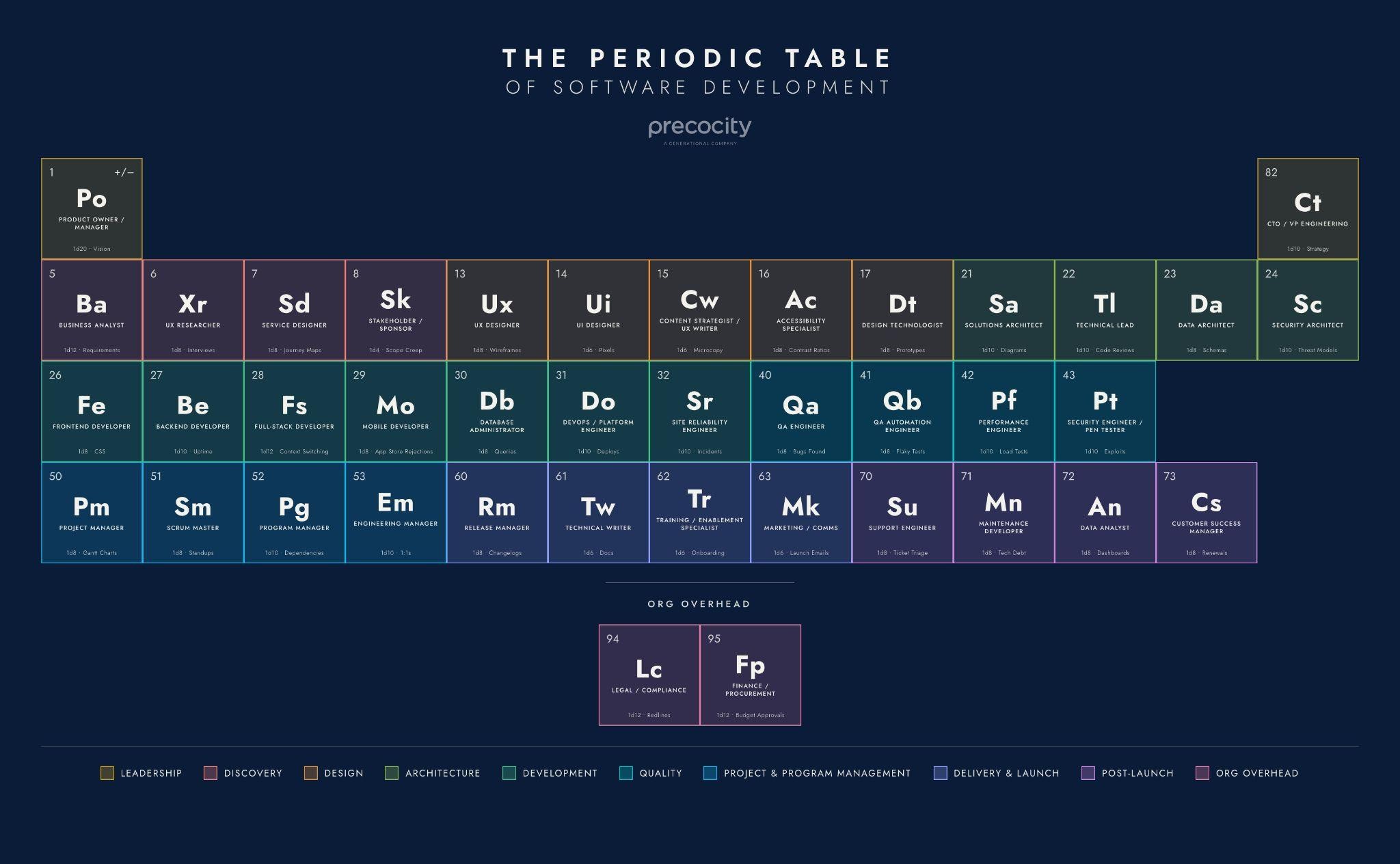
View an interactive version here: Periodic Table of Software Development
They were inherited.
McLuhan's argument about the printing press is that the mechanical age took whole activities and shattered them into fragments: specialists, linear steps, separated functions. The assembly line is that same logic pointed at making things, each worker doing one small piece and passing it down. Fragmentation and specialism were the message of the mechanical age, no matter what it happened to be producing. Our discipline was born inside that logic and never thought to question it. Research over here, wireframes over there, visual design next, a handoff to engineering at the end. A relay of specialists, each polishing one fragment and sliding it to the next station.
Software comes out shaped like the org chart
In 1968, a programmer named Melvin Conway noticed something that has haunted software ever since. Organizations, he argued, are constrained to build systems that mirror their own communication structure. The classic illustration: put four teams on a compiler and you'll get a four-pass compiler. The shape of the group becomes the shape of the thing. We call it Conway's Law.
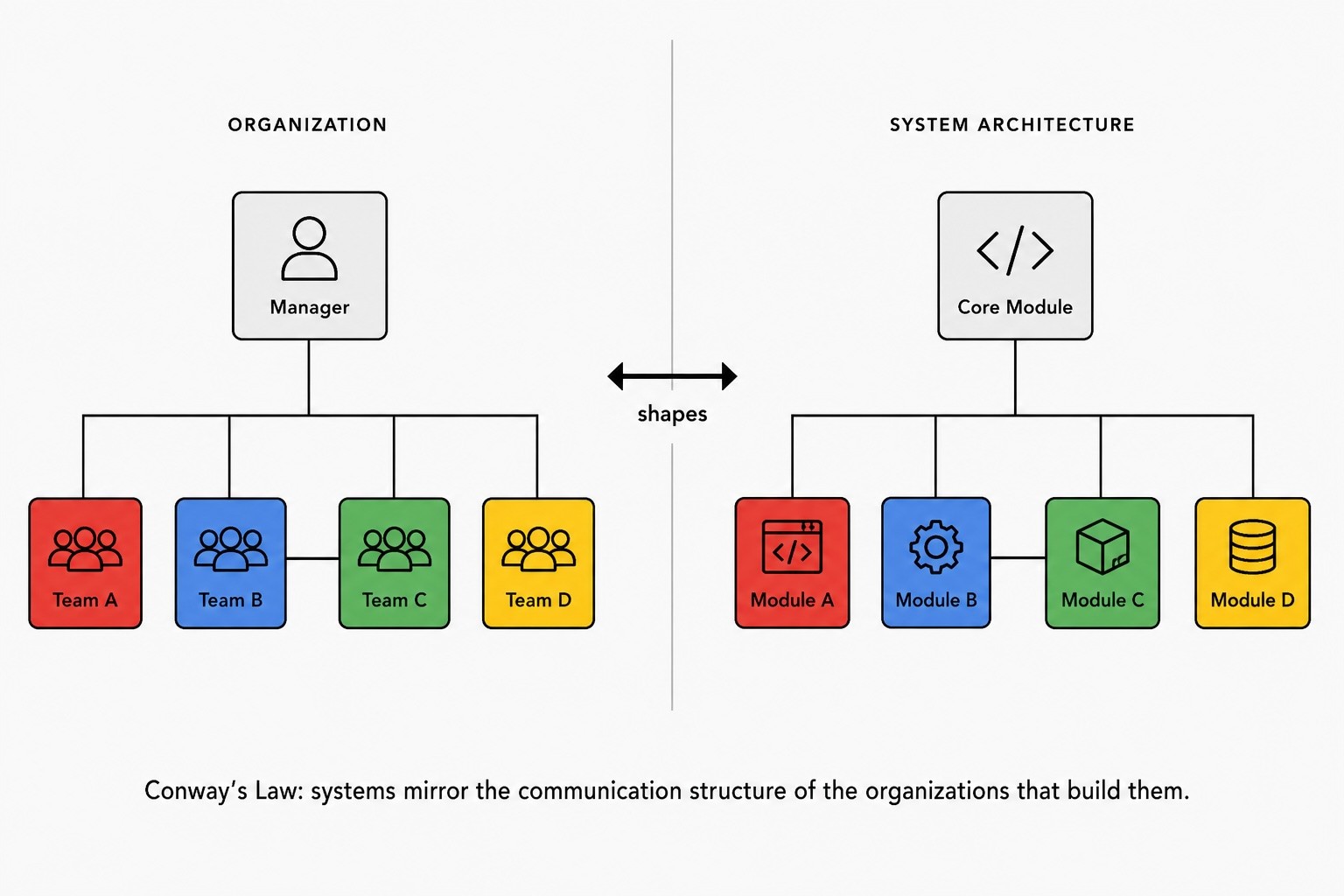
Point it at design and it stings. A team split into separate specialists, each in a separate tool, joined only by handoffs, produces work with the seams of those handoffs showing. The gap between the research and the interface, between the interface and the build, between the designed intent and the shipped reality: those gaps are the org chart, made visible in the product. You've felt them as a user. That slightly-off place where a beautiful screen meets a clunky flow is very often the spot where one specialist handed off to another.
Why the relay existed, and why it's dissolving
The relay wasn't only habit. It had a hard structural reason underneath it, the one this entire series has been circling. The designer could not build the thing. They worked in a tool that made pictures of software, so someone else had to translate the pictures into the real material. The handoff wasn't a preference or a sign of maturity. It was forced, because design and build happened in two different media.
Take that constraint away and the justification goes with it. When you can shape the running product directly, the wall between the person who designs it and the person who makes it real stops being a law of physics and becomes a choice. Usually a choice made out of habit, because the old shape is still sitting there.
McLuhan saw this reversal coming. Automation, he argued, runs the opposite direction from the assembly line. Where the mechanical age fragmented and separated, the automated, information-saturated age is integral and decentralized: it dissolves the narrow "job," the single repeated task on the line, and asks instead for a "role," which pulls a person into the whole. And that's exactly what happens when you make in the medium. You cannot cleanly separate the UX from the UI from the front-end from the back-end and all their connective tissues when all are the same living thing moving under your hands. Those separations were artifacts of a world where they were literally different files, in different tools, owned by different people. Collapse the tools into one medium and the roles want to collapse too.
The catch that the tool vendors won't mention
Conway's Law cuts both ways, and this is the sentence to tape to your monitor: if you adopt the new medium and keep the old org, the org wins.
You'll use AI to generate nicer representations faster, and then throw them over the very same walls, to the very same specialists, through the very same handoffs. The seams will still show, because the communication structure that produces the seams is still there. New medium, old org, same seams. The tool does not reshape the team. Only you can do that, and only on purpose.
Which is the answer to the question the last piece left hanging. Staying engaged and aware in a frictionless medium can't be a heroic act by one designer surrounded by people on autopilot. It has to be built into the shape of the team: fewer people, each involved in more of the whole, each able to see and touch the living thing, each responsible for keeping it honest rather than for buffing one fragment and passing it along. Awareness isn't a task you assign. It's a structure you build.
Back to the turtle in my own project
So, the Craft CMS developer. The handoff made after all my talk about killing handoffs.
Here's the honest version. We did collapse most of the relay. There was no research-to-wireframe-to-visual-to-prototype-to-spec-to-engineering chain, because we designed by building the real thing. But at the very end, we handed the working site to a developer to rebuild inside a content system, because the client has to live with this site long after we're gone, and they need it in a medium they can operate without us. That last translation wasn't a failure to honor the thesis. It was the thesis, applied with judgment.
Because the goal was never zero handoffs. That's a fantasy, and this series began by refusing fantasies of arrival. Software is never done (until it's deleted). Software gets built, owned, and maintained by different people, in different media, across the years. Pretending otherwise is just going numb. The goal is fewer translation steps, and honesty about those that remain: which medium each person works in, which medium each person will maintain, and why. We didn't reach the bottom of the stack. Nobody does. We chose a better altitude than the old process would ever have allowed, kept one deliberate handoff because the client truly needed it, and said so out loud instead of pretending it wasn't there.
Fewer turtles. Or more turtles depending on how you think of it. And those that remain, chosen on purpose.
There's a quieter reward in this. The fragmented job, one specialist buffing one fragment, was never where the work felt most alive. The involved role, one person shaping the whole living thing, sits much closer to the deep engagement, the flow Csikszentmihalyi called our best state. Re-fusing the team does more than speed things up. It's more awake, and more human, for the people doing it. Which matters more than it sounds, because the people delivering the work are those who have to believe in it.
Make the message in its medium
AI didn't upgrade our tools. It handed us our medium.
We are no longer drawing the future and praying it survives the trip to code. We can build it in the material it's actually made of. And when the medium is the message, we owe it to both to make our message in its medium. A delivery team that does that is a different thing, not a faster version of the old one, and we are the ones who get to design it.
One last honesty, the one I promised in the very first piece.
When the next medium arrives, the one after this, someone will notice that what we're calling the real thing was itself just another layer, and they'll write this essay again about a rung none of us can see from here. They'll be right. It was true of the punch card and the compiler and the graphical interface, and it's true of this. That isn't a caveat, and it isn't a hedge. It's the job. We were never going to reach the bottom.
We just get to choose, for our moment, how honestly we stand on the turtle we've got.
The end (for now).
Part I • Part II • Part III • Part IV
Given the density of the material and the rich works of giants upon which it stands, I felt compelled to include a bibliography here with all of the works I referenced while writing this. Blame my grad-school professors Thom Gillespie and Dr. Julia Fox if you need to.
Works Referenced
McLuhan, Marshall. Understanding Media: The Extensions of Man. McGraw-Hill, 1964.
McLuhan, Marshall, and Quentin Fiore. The Medium is the Massage: An Inventory of Effects. Bantam Books, 1967.
Conway, Melvin E. "How Do Committees Invent?" Datamation, vol. 14, no. 4, 1968, pp. 28–31.
Csikszentmihalyi, Mihaly. Flow: The Psychology of Optimal Experience. Harper & Row, 1990.
Engelbart, Douglas C. Augmenting Human Intellect: A Conceptual Framework. Summary Report, Stanford Research Institute, 1962.
Engelbart, Douglas C., and William K. English. "A Research Center for Augmenting Human Intellect." Fall Joint Computer Conference, San Francisco, 9 December 1968 — the demonstration later known as "The Mother of All Demos."
Heidegger, Martin. Being and Time. 1927. (Ready-to-hand / present-at-hand.)
Licklider, J. C. R. "Man-Computer Symbiosis." IRE Transactions on Human Factors in Electronics, vol. HFE-1, 1960, pp. 4–11.
Manovich, Lev. The Language of New Media. MIT Press, 2001. (The principle of "variability.")
Norman, Don. The Design of Everyday Things. Basic Books, 1988; revised 2013. (The gulfs of execution and evaluation.)
Reeves, Byron, and Clifford Nass. The Media Equation: How People Treat Computers, Television, and New Media Like Real People and Places. CSLI Publications / Cambridge University Press, 1996.
Churchill, Winston. Remarks in the House of Commons, 28 October 1943: "We shape our buildings; thereafter they shape us."
Smothers, John. Post on X, July 8, 2026. https://x.com/smothers_john/status/2074899740685447403
Ovid. Metamorphoses, Book III, c. 8 CE. (The Narcissus myth.)
"Turtles all the way down." Origin uncertain; the anecdote is commonly attributed to exchanges involving Bertrand Russell and William James.