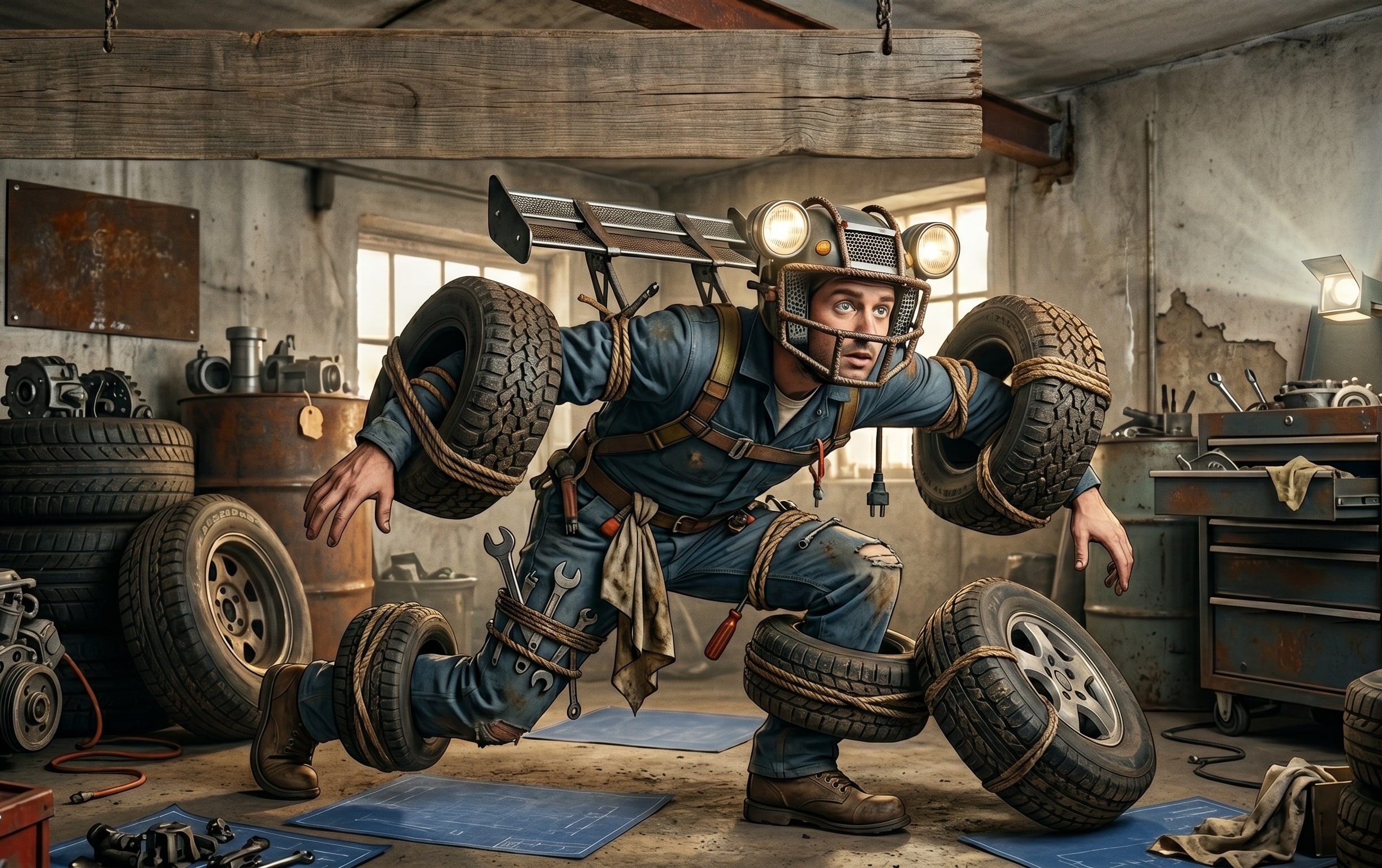
"Being in a garage doesn't make you a car."
Yes, that's a weird way to open. I've been saying it for a while. Stay with me.
Anthropic shipped Opus 4.7 recently, and with it Claude Design — a design tool that turns a prompt into a working website or a finished deck. Figma and Adobe's stock both dropped as a result. The implicit story: if the model can produce the artifact, the people who used to produce it are in trouble.
I think that story is wrong, and I want to be specific about why.
The Tool Was Never the Moat
For as long as I've been doing this work, people have confused the tool with the craft.
I recall many years ago, a small print shop that we used had a print manager — really nice guy who we'll call Brian — who one day showed me what he had produced in Photoshop. It was terrible/awful/atrocious, but he didn't know it, and was quite proud of it (if I recall, it was some weird display font that he had overlaid over a bad gradient). He called it a logo design. It wasn't.
Owning Photoshop didn't make him a designer in 1997. Owning a Sketch seat didn't make you one in 2015. Having a prompt box in 2026 isn't going to either. The tool has never been the moat. It was always the thing downstream of the moat.
The moat was creativity, judgment, and experience. The years you spent making bad things before you could make good ones. The client work that taught you which decisions actually matter. The taste you built from looking at ten thousand examples until your opinions about them were worth trusting.
The confusion is understandable, because from the outside the artifact looks the same. A page is a page. A deck is a deck. A working prototype runs whether a senior designer built it or a model did.
What you can't see from the outside is the thousand decisions behind it. Which of three layouts is actually right for this audience. Why the page feels wrong when the grid is correct. Where the copy hierarchy breaks down under real use. Why the obvious solution is the wrong solution in this industry.
A tool produces options. It cannot tell you which option is right. That judgment is the thing. It has always been the thing.
What AI Scales, and What It Doesn't
Tools like Claude Design genuinely do let a designer scale. I can put a system in front of a product manager, or an engineer, or a team member who doesn't have my background, and what they produce now is closer to what I would have produced than what they could have made a year ago. The baseline rises. The throughput rises. The volume of acceptable work a non-specialist can ship goes up.
That's real. It matters. It's part of why we've been investing where we have.
But the judgment on whether the output is actually good doesn't travel with the tool. Whether it solves the brief. Whether the brief was even right. Whether the thing that looks polished is aimed at the wrong audience. Whether the pattern someone reached for is the correct one or just the familiar one.
That judgment stays with whoever spent the years building it. You can hand someone the tool. You cannot hand them the taste that tells them the output is wrong.
I'm writing from a designer's seat because that's my background, but the pattern isn't specific to design. The same shift is happening in engineering, in writing, in strategy, in law. Anywhere a discipline used to require years of practice just to produce the artifact, and suddenly doesn't. The output-producing work compresses. The judgment-applying work does not. If your value has depended on the producing, this is a hard few years. If your value has been in the judging, the tools are a multiplier.
What This Means for How We Sell
If I'm right about this, it has practical implications for how we run Precocity.
For most of consulting's history, the industry sold hours. Time and materials prices the keyboarding. It prices the thing that's getting commoditized. That's the wrong side of the shift.
We've been moving to outcome pricing, which prices what the keyboarding was always downstream of: the judgment about what should exist and how it should work. A week like this one clarifies why. The tools that just shipped make the artifact cheaper. The people who know whether the artifact is any good are worth more, not less.
That has always been the moat. It just took a model that can produce the artifact for the moat to be more visible.
Having the tool doesn't make you the practitioner. Buying a guitar doesn't make you a guitarist. Being in a garage doesn't make you a car.
P.S. Yes, the garage/car line is trite. I'm not going to fix it.